
Office Flooring Trends in 2026

FLOORING BRANDS AUSTRALIA
Flooring Design Trends 2026/27
Colour, Pattern & Material Direction

Heading into 2026/27, flooring is doing more than providing a foundation. Across workplace, hospitality, education and commercial interiors, flooring is increasingly being used to establish mood, define zones and connect the overall material palette.
The strongest direction is clear: interiors are becoming warmer, more tactile and more connected to the natural environment.

1. Warmer, Earth-Inspired Colour

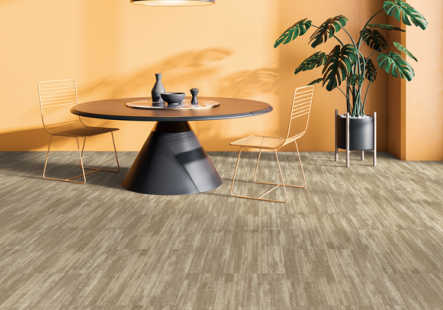
The dominance of cool grey is continuing to soften. Warm neutrals, sand, stone, taupe, clay and earthy browns are becoming important base colours, complemented by muted greens and nature-inspired tones.
For flooring, this translates beautifully into:

  • warm greige and stone
  • sand and natural beige
  • muted olive and eucalyptus greens
  • clay and terracotta influences
  • deeper charcoal and mineral tones
  • natural and warmer timber colours
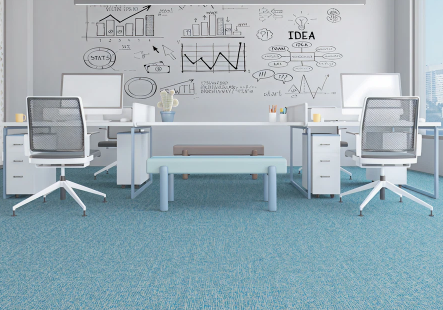
  • Blue is also gaining momentum, ranging from soft mineral blue through to deeper, moodier shades.

2. Pattern Becomes More Organic

Pattern remains important in 2026/27, but it is becoming less rigid. Rather than relying solely on obvious geometric repeats, designers are exploring patterns influenced by landscapes, water, stone, vegetation and naturally occurring irregularity.
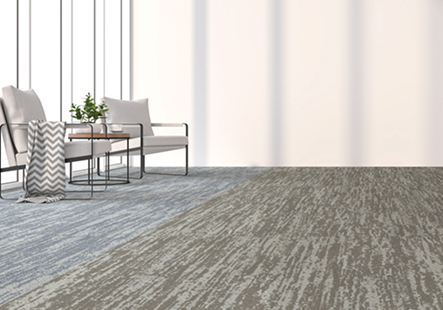
In carpet tile particularly, subtle tonal variation and organic pattern can create movement across a floor without overwhelming the interior. The result is a floor that feels considered from a distance while revealing greater texture and detail up close.

3. Nature Remains a Major Influence

Biophilic design continues to influence commercial interiors, with flooring playing an important role through earthy colour, texture and natural references.
Importantly, nature-inspired design doesn’t have to be literal. A forest doesn’t need to become a leaf pattern. A coastline doesn’t need to become a wave. Instead, colour, texture and irregular movement can capture the character of a landscape in a much more sophisticated way.
For Australian projects, this creates enormous scope to draw inspiration from our distinctive coastlines, bushland, waterways and geological landscapes.

4. Mixing Materials to Define Space

Another strong direction is the combination of resilient flooring and carpet tile within open spaces. Changes in flooring can intuitively distinguish circulation areas, work zones, meeting spaces and breakout areas without relying on physical barriers. This approach is particularly relevant to workplace, education and hospitality design.

The 2026/27 Direction
For architects and interior designers, the opportunity in 2026/27 is not about following a single trend. It is about creating floors with greater warmth, tactility and connection to place — combining colour, pattern and material in a way that supports the broader architectural concept.
At Flooring Brands Australia, we see the floor as part of the design story  not simply the surface beneath it.

Industry references

HIA — Designing Tomorrow’s Palette — https://hia.com.au/our-industry/housing/business-and-digital/2026/02/designing-tomorrows-palette
ABI Interiors — Top Interior Design Trends — https://www.abiinteriors.com.au/the-interior-edit/top-interior-design-trends/
Stonhard — 2026 Commercial Flooring Trends — https://www.stonhard.com/blog/2026-commercial-flooring-trends-whats-next-in-epoxy-and-beyond/
Benefits of Commercial Carpet Tiles

Benefits of Commercial Carpet Tiles

A practical, flexible flooring solution for contemporary commercial interiors

Commercial carpet tiles continue to be a practical flooring choice for workplaces, education, hospitality and other high-traffic interiors. Combining design flexibility with straightforward installation and maintenance, today’s carpet tile collections can also play an important role in creating comfortable, adaptable commercial spaces.

Design Flexibility

One of the biggest advantages of carpet tiles is the freedom they give designers. Colours, textures and patterns can be used individually or combined to create subtle zoning, directional layouts or more distinctive feature areas.

Plank and square formats also allow for a variety of installation patterns, helping designers tailor the floor to the scale and character of the space.

Easy Maintenance & Replacement

Unlike broadloom carpet, individual tiles can be removed and replaced if they become damaged, heavily stained or worn. This can significantly reduce disruption and help extend the useful life of a commercial flooring installation.

For busy workplaces and public environments, that flexibility is a major practical advantage.

Ideal for Changing Workspaces

Modern commercial interiors are increasingly designed to evolve. Carpet tiles work particularly well in adaptable offices where layouts, workstations and services may change over time.

Individual sections can be lifted to access underfloor services and reinstated without replacing an entire floor covering.

Acoustic Comfort

Carpet tiles can help soften commercial interiors by reducing impact noise and sound transmission within a space. This is particularly valuable in open-plan offices, meeting areas, education environments and shared working spaces where acoustic comfort is an important design consideration.

Comfort Underfoot

Along with acoustic benefits, textile flooring introduces warmth and softness into commercial environments. It can provide a welcome contrast to harder finishes such as concrete, timber-look flooring and resilient surfaces.

A Practical Commercial Flooring Solution

With durability, design flexibility and ease of maintenance, commercial carpet tiles offer a versatile solution across a wide range of projects.

For architects and designers, the opportunity to combine colour, texture and pattern provides another layer of creative freedom — while still meeting the practical demands of contemporary commercial interiors.

Explore FBA Flooring’s commercial carpet tile solutions for your next project.

What Are Modular Carpet Tiles?

What Are Modular Carpet Tiles?

A flexible, practical flooring solution for contemporary commercial interiors

Modular carpet tiles are individual sections of carpet designed to be installed as a coordinated flooring system. Unlike broadloom carpet, which is supplied in large rolls, carpet tiles are laid piece by piece — giving architects, designers and facility teams greater flexibility in design, installation and ongoing maintenance.

Why Specify Carpet Tiles?

  • Design flexibility. Mix colours, textures and laying patterns to create subtle zoning, directional movement or feature areas across a floorplate.
  • Easy replacement. If a tile becomes stained or damaged, the affected module can usually be replaced without removing an entire floor area.
  • Efficient installation. The modular format is easy to handle and can simplify installation in occupied spaces or projects delivered in stages.
  • Practical access. Depending on the installation system, individual tiles can be lifted where access to underfloor services is required.
  • Commercial performance. Products designed for heavy-use interiors can provide the durability, acoustic comfort and underfoot feel required in busy workplaces and public environments.

A Tool for Interior Design

Carpet tiles have moved well beyond the traditional office grid. Contemporary ranges use tonal colour, organic texture, linear pattern and irregular visual movement to create floors that feel more considered and less repetitive. Tiles can be installed monolithically for a continuous look, quarter-turn for added movement, or in directional layouts to reinforce circulation and zoning.

This makes modular carpet particularly useful in open-plan environments, where flooring can help define collaboration zones, quiet work areas and circulation paths without introducing physical barriers.

Where Do Modular Carpet Tiles Work Best?

They are widely specified for commercial offices, education, libraries, hospitality, retail, meeting rooms and other high-use interiors where design flexibility and maintainability are important.

Maintenance and Lifecycle

Routine vacuuming and an appropriate commercial cleaning program help maintain appearance over time. One of the strongest lifecycle advantages is selective replacement: worn or damaged tiles can be changed in targeted locations, helping extend the useful life of the overall floor and reduce disruption.

Considering Sustainability

For projects with environmental targets, look beyond appearance and assess the complete product specification. Depending on the manufacturer, considerations may include recycled content, low-emitting materials, third-party environmental documentation, take-back or recycling programs, and the ability to replace only damaged modules rather than an entire installation.

The bottom line: Modular carpet tiles combine creative freedom with practical commercial performance — making them a versatile choice for spaces designed to adapt over time.

Flooring Brands Australia

Commercial flooring solutions for Australian projects